

Most small business owners treat their star rating like a report card, nice to have, not urgent. The data says otherwise. Your rating behaves less like a vanity metric and more like a pricing lever.
The short answer: a full one-star increase in average rating has been shown to drive a 5 to 9% increase in revenue for a local business (Harvard Business School, Luca). McKinsey found the effect can run even higher in some categories, with businesses moving from a 4.2 to a 4.5-star average seeing revenue gains of 30 to 50%. In 2026, the bar for "acceptable" has also moved. 68% of consumers now say they need at least a 4-star average before they'll consider a business at all, up sharply from previous years (BrightLocal), and 98% of consumers say they rely on reviews to inform their purchase decisions in the first place (Harvard Business Review, 2025). Your rating isn't just feedback. It's a filter most customers apply before they ever see your menu, your price list, or your storefront.
What one extra star is actually worth
The most cited number in this space comes from a Harvard Business School working paper by economist Michael Luca, who studied the relationship between Yelp ratings and independent restaurant revenue. He found that a one-star increase in rating was associated with a 5% to 9% increase in revenue (Luca, Reviews, Reputation, and Revenue: The Case of Yelp.com, Harvard Business School).
More recent research puts an even sharper number on it. McKinsey's analysis of online ratings found that businesses moving from a 4.2-star average to 4.5 stars saw revenue increases of 30 to 50% in the categories studied, worth hundreds of millions of dollars in some companies (McKinsey, "Why business must heed customer reviews"). That's a smaller jump in stars than Luca's full-point study, which makes the size of the return even more notable.
That's not a one-off click-through bump. It's a structural revenue effect, because a rating changes behaviour at the exact moment a customer is deciding whether to walk in, call, or scroll past. It also helps explain why the shift is accelerating: global review volume roughly doubled in the year after COVID-19 hit, so ratings now carry more weight in a noisier field of competitors than they did a few years ago (McKinsey, 2026).
Take a business turning over $200,000 a year. The top of Luca's range, a genuine full-star jump, is rare but not impossible for a business starting from a mediocre baseline, and it would be the difference between a flat year and a materially better one. Even the conservative end of that range is worth taking seriously when the fix, asking happy customers for a review at the right moment, costs nothing but a little friction removal.
The bar is rising in 2026, not falling
If you're thinking "we're already above 4 stars, so we're fine," check the number again, because the threshold customers apply has moved up:
- 68% of consumers now say they require a minimum 4-star average before they'll use a business, up from 55% the year prior (BrightLocal, Local Consumer Review Survey 2026).
- 31% require 4.5 stars or higher, nearly double the 17% who said the same the year before (BrightLocal, 2026).
- 97% of consumers read reviews for local businesses before making a decision, and 41% say they check reviews every single time (BrightLocal, 2026).
- 98% of consumers rely on reviews to inform a purchase decision at all, according to a large-scale study of over 111,000 reviews and 2,000 shoppers (Harvard Business Review, 2025).
Read those together and the picture is clear. The average consumer isn't just glancing at your rating anymore. They're applying a hard cutoff, and that cutoff keeps climbing. A 3.8-star average that would have been perfectly competitive two years ago is now filtering out roughly a third of the people who land on your profile before they've read a single review.
Rating vs. review count: which matters more?
Both matter, but not equally, and not for the same reason.
Your rating is the strongest consumer-trust signal and one of the most heavily weighted local search ranking factors. "High Numerical Google Ratings (e.g. 4-5)" is the second-most impactful individual local pack ranking factor measured in Whitespark's 2026 Local Search Ranking Factors report, behind only your primary business category (Whitespark, 2026).
Your review count matters differently. It's less about the algorithm and more about consumer confidence. Whitespark's report still places "Quantity of Native Google Reviews" inside the top 10 ranking factors, but its bigger job is reassurance: customers want to see enough reviews to trust that the rating is real, not a handful of friends and family.
The practical implication for a small business is that a high rating from a thin pool of reviews, say 4.9 stars from 6 reviews, doesn't carry the same weight, in either ranking or trust, as a strong rating built on volume. Growing both together, asking consistently rather than in a single burst, is what actually moves the number that matters.
How to protect and grow your rating without gaming it
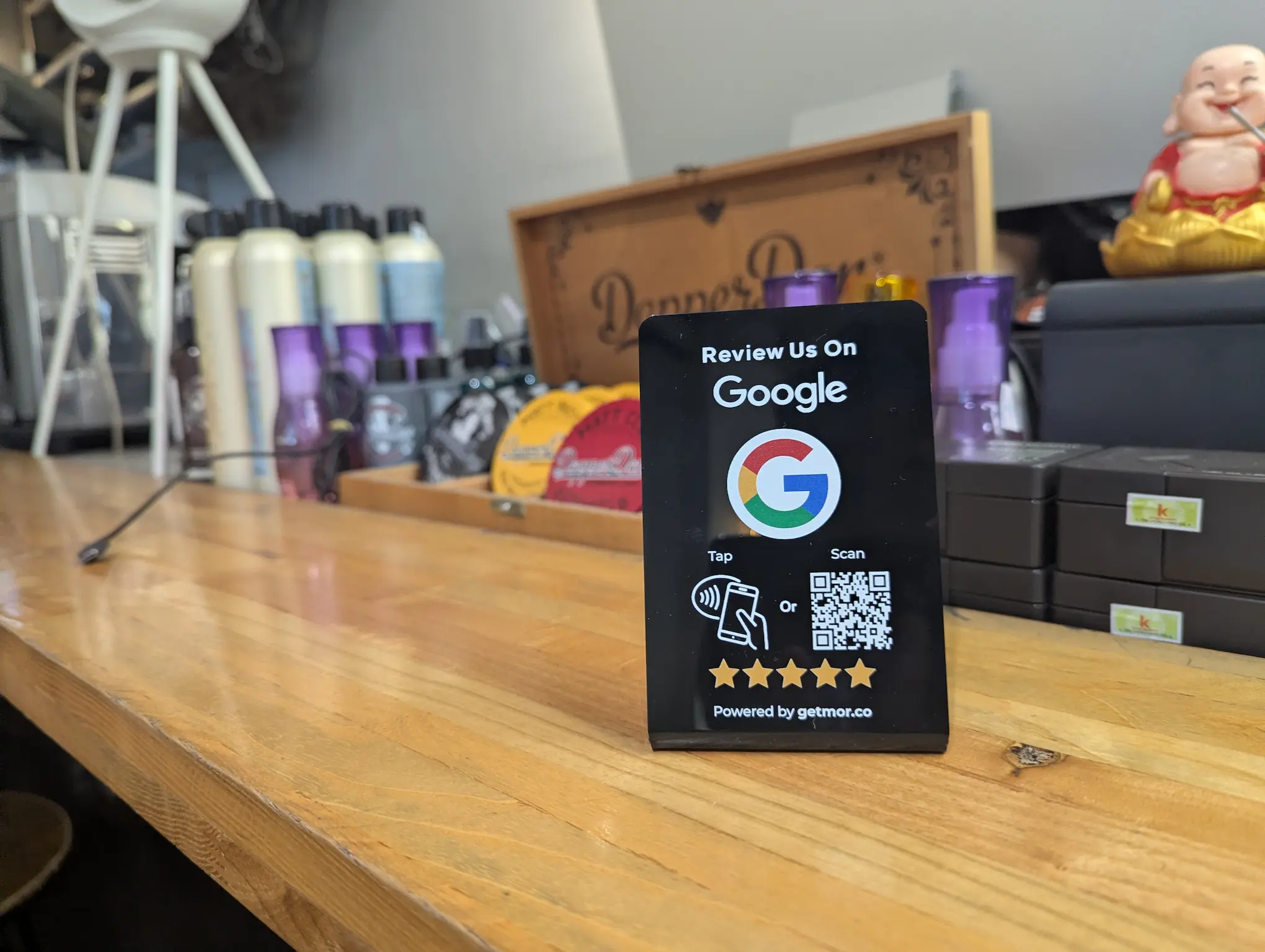
Improving your rating honestly comes down to friction removal, not a trick. Two things determine your average: how many unhappy customers feel motivated enough to complain publicly, and how many happy customers ever get asked. Left alone, the unhappy ones self-select to leave reviews far more often, because frustration is a stronger motivator than satisfaction. The fix is asking every happy customer, right at the moment they're happiest, and making it a single tap rather than a six-step search.
This is exactly the problem a Mor Google Review Plate or Stand solves. No app, no searching, just a tap at the counter that opens your review form directly. It costs nothing recurring, and it works on the customers who'd never have thought to leave a review unprompted, which is exactly the group that moves your average upward.
Frequently asked questions
How much revenue difference does one star actually make?
A Harvard Business School study of Yelp-rated restaurants found a one-star increase in rating was associated with a 5 to 9% increase in revenue (Luca, HBS). McKinsey's more recent analysis found businesses moving from 4.2 to 4.5 stars saw gains as high as 30 to 50% in some categories.
What's the minimum star rating I need to stay competitive in 2026?
BrightLocal's 2026 survey found 68% of consumers require at least 4 stars before considering a business, and 31% now require 4.5 stars or higher. Both figures rose sharply from the previous year.
Does my rating or my review count matter more for Google Maps ranking?
Rating carries more individual weight. It's the second-most impactful local pack ranking factor in Whitespark's 2026 report, but review count and recency are also top-10 factors, so both matter together rather than one substituting for the other.
Can I just ask unhappy customers to update their review instead of chasing new ones?
You can politely follow up on a resolved complaint, but the better long-term strategy is asking every happy customer at the point of sale, since unhappy customers already tend to leave reviews at a higher rate without being asked.
Written by David Brewers
David Brewers is a content lead at Mor, covering local SEO, Google reviews, and small business growth. Based in Brisbane, he writes about what actually works for cafes, salons, and service businesses turning happy customers into five-star reviews.